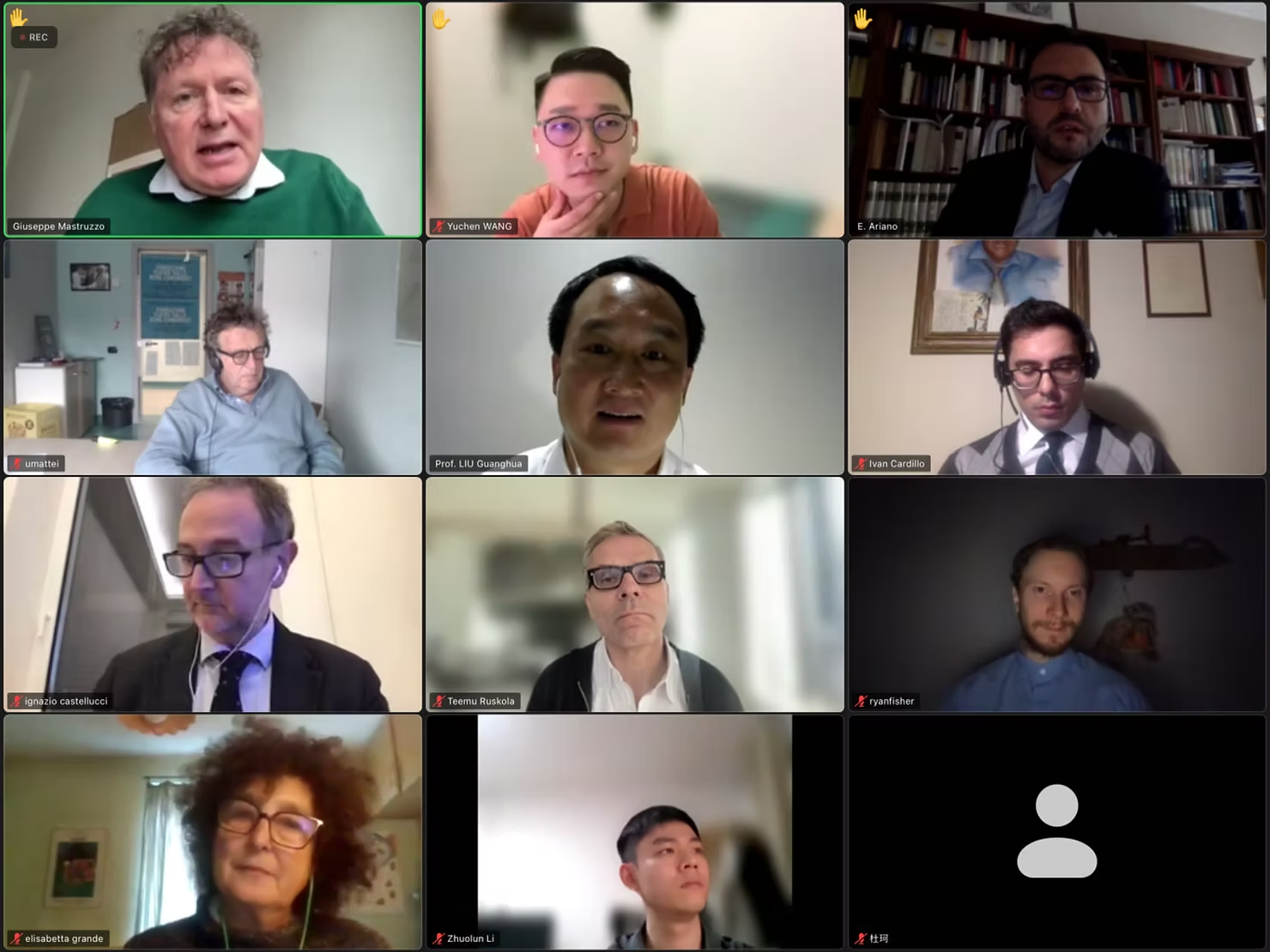
A Joint Scholarly Seminar
On 4 December 2023, the Lanzhou University Center for Italy Studies and the International University College of Turin Center for Chinese Studies held a joint online seminar on the reception of Chinese law in Western academia.[web:182][web:63]
The meeting brought together scholars in international and comparative law to discuss China’s participation in global governance, the evolution of legal orientalism, and new frameworks for understanding legal systems beyond Western centralism.[web:177][web:180][web:183]

Welcome Remarks: Professor Liu Guanghua
Director, Lanzhou University Law School Center for Italy Studies
Professor Liu recalled the long‑standing cooperation between Lanzhou University and the IUC, which has spanned more than fifteen years of joint seminars, exchange programs, and shared research.[web:182][web:185]
He situated the seminar against the backdrop of China’s growing role in initiatives such as the Belt and Road and emphasized the importance of mutual learning between legal cultures for building confidence in the rule of law on the basis of dialogue among civilizations.[web:185][web:177]
“We need to strengthen our confidence in the rule of law on the basis of exchange and mutual learning among the world’s outstanding civilizations, and actively explain the concepts and successful practices of the rule of law with Chinese characteristics to foreign audiences.”

Keynote Speech: Professor Ugo Mattei
International University College of Turin, Academic Coordinator
From Legal Orientalism to a Multipolar Order
Professor Mattei revisited his earlier work on “comparative international law”, which argues that international law is not a single universal system but a field in which different regions develop distinct understandings and doctrines.[web:177]
He linked this to Teemu Ruskola’s concept of legal orientalism, which describes how Euro‑American scholarship has long treated Chinese law as the negative mirror of Western legality, and asked whether China might now become a central producer of legal concepts in a genuinely multipolar order.[web:177][web:180][web:183]
Drawing on his earlier taxonomy of “three patterns of law” – professional, traditional, and political – Mattei suggested that contemporary China does not fit neatly into Western categories and that understanding its legal development requires moving beyond familiar rule‑of‑law rhetoric.[web:177]
“Our ambition in this seminar series is to play for today’s world a role similar to the Cold War dialogues in comparative international law: building bridges of understanding across legal systems that are often framed as adversaries.”

Keynote Speech: Professor Teemu Ruskola
Author of Legal Orientalism: China, the United States, and Modern Law
Reception, Comparison, and “Legal Orientalism”
Professor Ruskola used the metaphor from Italo Calvino’s Invisible Cities – Marco Polo describing other cities in order to speak about Venice – to illustrate that comparison always says something about the observer as well as the object observed.[web:180][web:183]
He argued that the “reception” of Chinese law in Western academia is never a neutral discovery of facts but an act of engagement that is shaped by historical power relations and by the frameworks of international law that display states as objects in a global “exhibition.”[web:177][web:183]
Ruskola’s notion of legal orientalism shows how Euro‑American law has positioned itself as universal while casting Chinese law as culturally particular, a hierarchy that continues to structure debates on trade, human rights, and legal reform today.[web:180][web:183]
“Through acts of comparison, we create and maintain our ‘others’ as well as ourselves. The reception of Chinese law is therefore not merely descriptive but constitutive, with ethical and political consequences.”

Toward a New Comparative International Law
The seminar marked a new phase in the collaboration between Lanzhou University and the IUC, aimed at rethinking comparative international law from the perspective of a genuinely multipolar world rather than Western centralism.[web:63][web:182]
Participants converged on the idea that taking Chinese law seriously as a source of concepts and theory – rather than merely an object of comparison – is essential for any future global legal order based on mutual respect and dialogue.[web:177][web:183]
The full transcription of keynote speeches and discussion is available in the downloadable PDF above for readers who wish to explore the seminar in greater depth.