A seminar by Professor Nidhi Srinivas
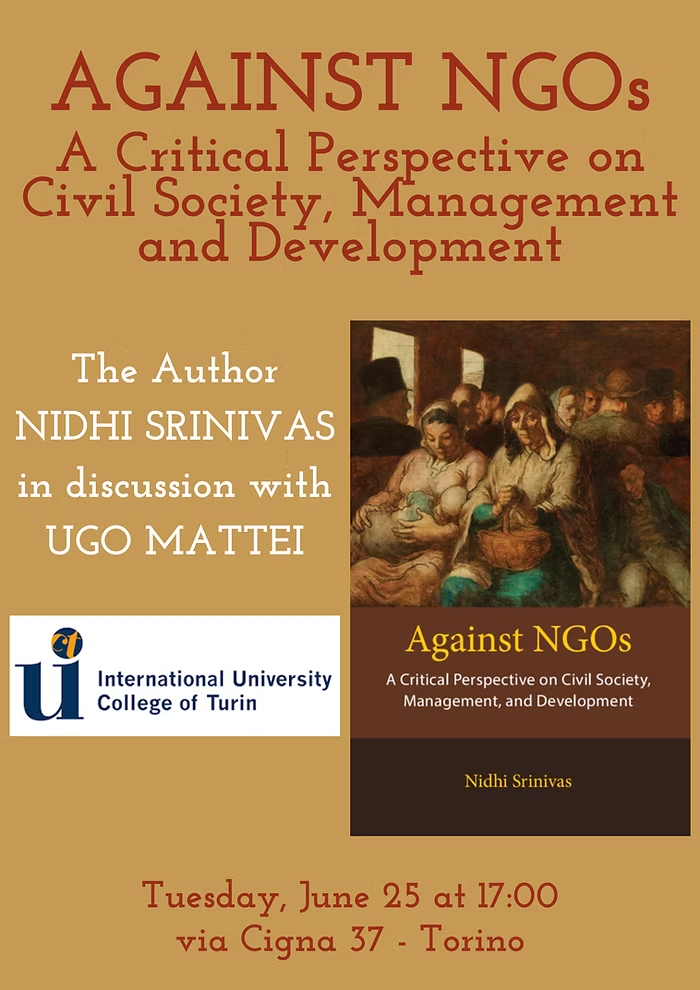
What would development look like if its practitioners and scholars were "against NGOs," challenging common sense about them? In our seminar, a critical perspective on NGOs is offered, describing how they emerged as key agents of development over time.
📚 Seminar Overview
Through an interpretative history based on Gramscian concepts, we discuss how civil society organizations were gradually enlisted in development as non-state technocratic actors, and argue that management studies and development studies emerged as commonsensical explanations for capitalist crises.
Each offered complementary solutions to balance the needs of capital and society, in particular historical circumstances. These solutions also situated civil society as agents of development and vectors of management.
🎯 Key Discussion Points
- The historical emergence of NGOs as development agents
- Gramscian analysis of civil society organizations
- Management studies as response to capitalist crises
- Civil society as vectors of management
- Technocratic approaches to social change
About Professor Nidhi Srinivas
Nidhi Srinivas is Associate Professor at Milano School of Policy, Management, and Environment. His research focuses on social innovation and postcolonial studies, mobilizing critical theory to study a variety of topics, including management history, international development, mutual aid, ecological politics and civic design.
He publishes widely and has received several fellowships, including from the Japan Society for Promotion of Science, Erasmus Mundus, the India China Institute, and the BRICS policy center.
He has also served as visiting professor at different institutions, including the ITC-ILO, Turin; Hitotsubashi University, Tokyo; Sao Paulo School of Business Administration; and the Indian Institute of Management Bangalore.
Teaching focus: Professor Srinivas' classes enhance students' ability to critique and integrate theories, with a particular focus on design, inclusion and social justice.
The seminar at Campus Leone Ginzburg provided students with tools to critically examine the role of NGOs in contemporary development practice and to imagine alternative frameworks for social transformation beyond technocratic management approaches.
About the Campus Leone Ginzburg Series: This seminar is part of an ongoing series of critical discussions hosted at the IUC's Campus Leone Ginzburg, bringing together scholars and practitioners to examine contemporary challenges in law, development, and social justice.